
Home / Game Library / The White Castle
Free TABLE Method™ Preview
Coming soon
The White Castle
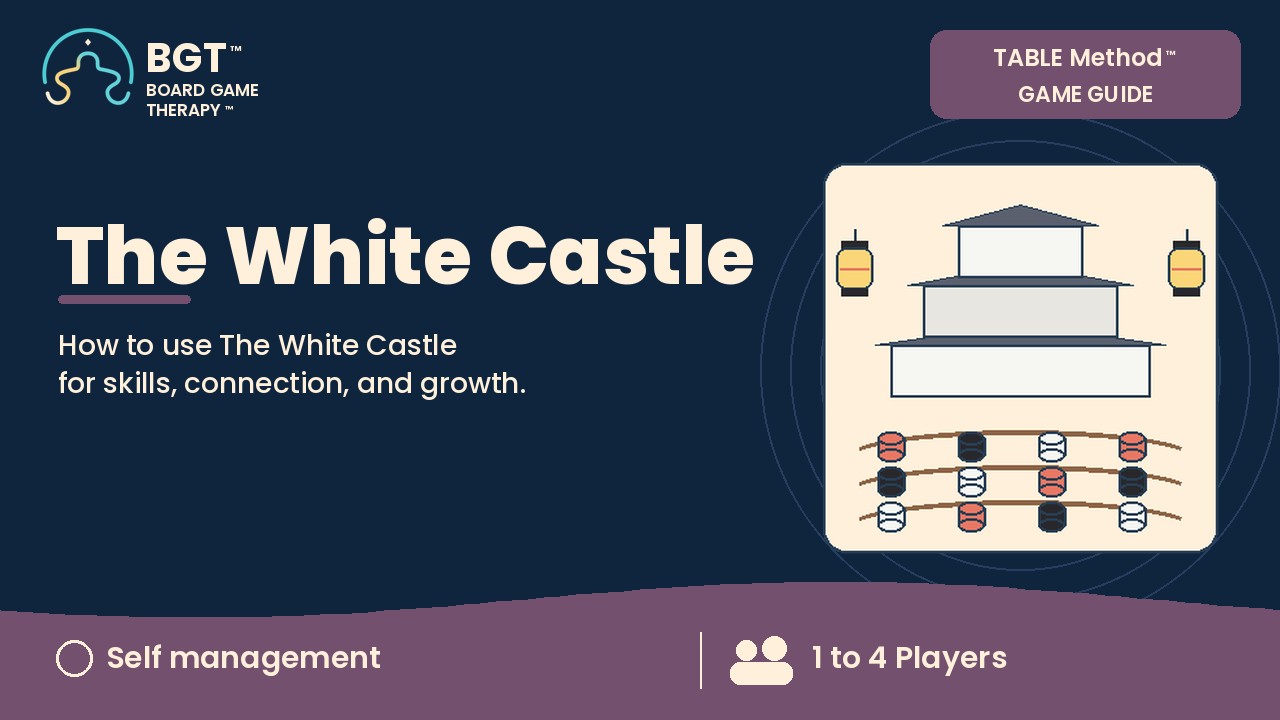
A dice placement and worker placement game set at Himeji Castle in 1761: clans send courtiers, gardeners and warriors to gain favour · 1 to 4 players
Coming soon See the TABLE plan
What the Game Is
Each player leads a minor clan at Himeji Castle. The game lasts 3 rounds, and each player takes 3 turns per round. On a turn you take a die from either end of a bridge and place it on a space with a die icon, paying or gaining coins for the difference in value. Then you carry out that space's actions: send a courtier into the castle, a gardener to a garden or a warrior to a training yard, or gain resources. Clan Points come during play and at the end, and the player furthest on the Clan Points track wins.
Why It Works at a Table
Each turn asks a player to choose one die from a short row and decide where it does the most good, while others may take the die they wanted. That gives a clear way to talk about planning ahead, timing and adapting when an option is gone, all inside the game.
Try One Variation
First game setup (From the rulebook, not a separate variant). For your very first game, skipthe randomcards and tiles and use the setupshown in the rulebook picture (p.2).
- Targets: A gentler first game.
- Suits: Tables new to the game.
- Watch for: Agree it before setup.
- Debrief prompt: “Did the fixed setuphelp?”
The TABLE Method™, Applied
A short excerpt from the full guide's TABLE plan. Anyone can pass, pause, or stop at any time.
Target
Notice how players choose a die, how they adapt when a wanted die is taken, and how the table treats a lost option as a game event.
Assess
Check the player count, the time, and whether the game serves today's goal.
- Does everyone want a competitive game of about an hour, and has the group agreed to the setting after a preview?
- Can each player read cards and icons with chosen support?
- Do we have 2 to 4 players?
Build
- Show one turn with sample pieces: take a die from the end of a bridge, place it, settle the coins and carry out the action. Reset the samples first.
- Agree Pass for optional reflection, Pause for a break and Fold to halt play immediately for the whole table, plus a visible signal. These are session agreements, not new game actions.
- Offer reflection at the end of a round, never in the middle of a turn. A real Fold halts the whole table immediately.
Lead
- Name a taken die as part of the game, not a slight.
- Leave every die, action and clan choice with its owner.
- Read card and icon text aloud on request without advising.
Extract and Extend
Debrief in order: Board, Self, Us, Life or Work, Extension. Ask what participants make of the game. Do not tell them.
Quick Answers
What is The White Castle?
Each player leads a minor clan at Himeji Castle. The game lasts 3 rounds, and each player takes 3 turns per round.
Why use The White Castle at a table?
Each turn asks a player to choose one die from a short row and decide where it does the most good, while others may take the die they wanted.
What variation can I try with The White Castle?
First game setup. Targets: A gentler first game. Suits: Tables new to the game.
What does the TABLE Method™ target in The White Castle?
Notice how players choose a die, how they adapt when a wanted die is taken, and how the table treats a lost option as a game event.
Can a player pass or stop during a session?
Anyone can pass, pause, or stop at any time.
Does this guide include The White Castle?
Game not included; play by the rulebook in your box.
Game not included; play by the rulebook in your box. The White Castle is not named in the BGT book; the guide applies the book's TABLE Method to it as a companion title. Independent companion. Not affiliated with, endorsed by, or sponsored by Devir Games. The White Castle may be a trademark of its owner and is named only to identify the game. Board Game Therapy is not inherently psychotherapy. Copyright 2026 Solid State Strategies, LLC.
What's inside this guide
A dice placement and worker placement game set at Himeji Castle in 1761: clans send courtiers, gardeners and warriors to gain favour.
An extended TABLE Method™ companion for The White Castle. The game is not included; play by the rulebook in your box.
For a first session, read pages 4 to 6, pick the session plan for your role, and print the desk card and agreements card. Everything after that is there when you need it: more prompts, more debrief questions, adaptations, and fixes for common problems.
Players: 1 to 4: 2 to 4 with the standard rules and a solitaire mode for 1 player (p.16)
Session plan: Learning session: as many rounds as fit, about 90 minutes BGT window; may end unfinished
Run the game
- At a glance and rules summary p. 3
- Why this game, and the TABLE plan p. 4
- Running the session p. 5
- The five-rung debrief p. 6
- Fit, access, and repair p. 7
- Rule variations (4) p. 8
Plan the session
- Session plan: host or teacher p. 10
- Session plan: coach p. 11
- Session plan: licensed clinician p. 12
- A three-session series p. 13
Facilitate with depth
- Facilitator prompt bank p. 14
- Debrief question bank p. 15
- Adapting for ages, group sizes, and access p. 16
- Troubleshooting p. 17
Printables
- One-page desk card p. 18
- Table agreements card p. 19
- Session planning sheet p. 20
- Rounds and dice log and after-session notes p. 21
- Participant reflection (fillable) p. 22
Credits and license
- Credits, sources, scope, and evidence p. 23
- License and permitted use p. 24